ERP vs CRM: Key Differences, Benefits & Which One Does Your Business Need?
Many businesses struggle to decide between ERP and CRM software. While both improve efficiency and automate operations, they serve different purposes. This comprehensive guide explains the differences between ERP and CRM, their benefits, features, use cases, and how to choose the right solution for your business.
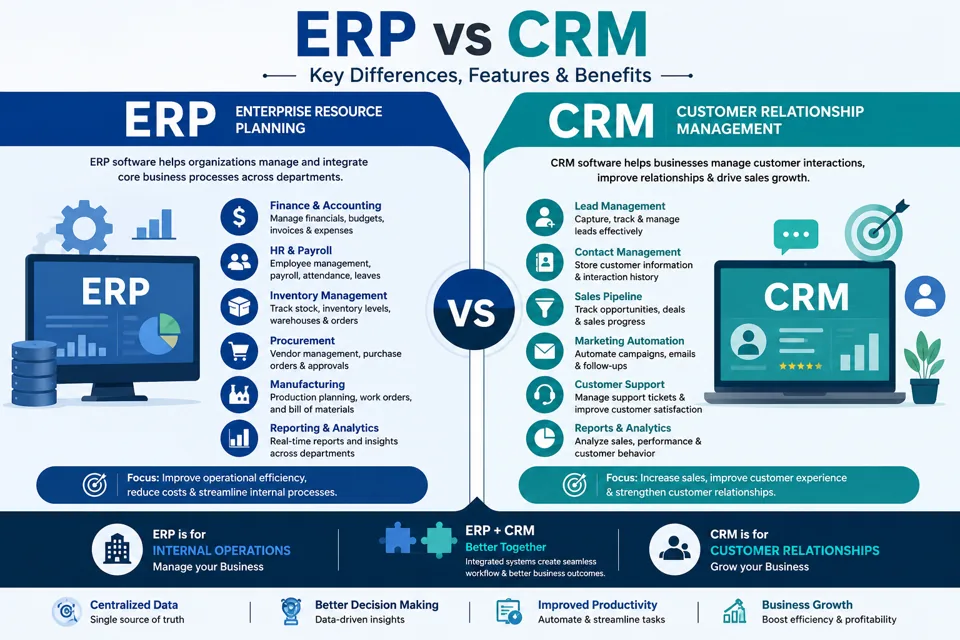
ERP vs CRM: What's the Difference? A Complete Business Guide (2026)
In today's competitive business landscape, organizations need powerful software solutions to streamline operations, improve customer satisfaction, and increase profitability. Two of the most popular business management systems are ERP (Enterprise Resource Planning) and CRM (Customer Relationship Management).
Although many people use these terms interchangeably, ERP and CRM solve different business problems. Understanding their differences can help your organization invest in the right technology.
In this guide, we'll explain ERP vs CRM in detail, compare their features, discuss their benefits, and help you determine which solution is best for your business.
What is ERP?
Enterprise Resource Planning (ERP) is a centralized software system that manages core business operations across multiple departments.
ERP integrates business processes into a single platform, allowing organizations to improve productivity, reduce manual work, and gain real-time insights.
Common ERP Modules
Human Resource Management (HRM)
Payroll Management
Finance & Accounting
Inventory Management
Procurement
Manufacturing
Warehouse Management
Sales & Distribution
Purchase Management
Asset Management
Project Management
Compliance Management
ERP acts as the backbone of an organization by connecting all departments through one database.
What is CRM?
Customer Relationship Management (CRM) software focuses on managing customer interactions and improving relationships.
CRM helps businesses track leads, manage sales pipelines, automate marketing, and provide better customer support.
Common CRM Features
Lead Management
Sales Pipeline
Contact Management
Opportunity Tracking
Customer Communication
Email Integration
Marketing Automation
Customer Support
Follow-up Reminders
Reports & Analytics
CRM is designed primarily for sales, marketing, and customer service teams.
ERP vs CRM: Key Differences
FeatureERPCRMPrimary FocusInternal OperationsCustomer RelationshipsMain UsersHR, Finance, Inventory, ManagementSales, Marketing, SupportData ManagedCompany ResourcesCustomer InformationGoalImprove operational efficiencyIncrease sales and customer retentionDepartmentsEntire OrganizationCustomer-facing teamsInventoryYesLimitedPayrollYesNoAccountingYesNoSales PipelineBasicAdvancedMarketing AutomationLimitedAdvancedCustomer SupportBasicExcellent
ERP Features
Modern ERP software offers numerous business management features.
1. Human Resource Management
Manage employees, attendance, payroll, leave, recruitment, and performance.
2. Inventory Management
Track stock levels, warehouses, purchase orders, and inventory movement.
3. Finance & Accounting
Manage invoices, expenses, GST, taxation, accounts payable, and accounts receivable.
4. Procurement
Automate purchasing, vendor management, and approvals.
5. Manufacturing
Manage production planning, bill of materials, and work orders.
6. Reporting Dashboard
Generate real-time reports for every department.
CRM Features
CRM systems focus on improving customer engagement.
Lead Management
Capture leads from websites, social media, Google Ads, Facebook Ads, and referral sources.
Contact Management
Maintain complete customer profiles with communication history.
Sales Automation
Automate follow-ups, reminders, quotations, and deal tracking.
Customer Support
Manage support tickets and improve response times.
Marketing Automation
Create campaigns, email marketing, SMS campaigns, and customer segmentation.
Analytics
Track sales performance, conversions, revenue, and customer lifetime value.
Benefits of ERP
Businesses implementing ERP software often experience significant improvements.
Improved Productivity
Employees spend less time on repetitive tasks.
Better Decision Making
Real-time dashboards provide accurate business insights.
Centralized Data
All departments access a single source of truth.
Cost Reduction
Automation reduces operational expenses.
Improved Compliance
Maintain GST, taxation, payroll, and regulatory compliance.
Scalability
ERP grows with your business.
Benefits of CRM
CRM helps businesses build stronger customer relationships.
Increased Sales
Sales teams close deals faster with organized pipelines.
Better Customer Experience
Track every customer interaction.
Improved Communication
Centralized customer records reduce confusion.
Higher Customer Retention
Timely follow-ups improve loyalty.
Sales Forecasting
Predict future revenue using analytics.
ERP Use Cases
ERP software is ideal for:
Manufacturing Companies
Retail Businesses
Wholesale Distributors
Healthcare Organizations
Educational Institutions
Logistics Companies
Construction Companies
Real Estate Businesses
Financial Institutions
Multi-location Enterprises
CRM Use Cases
CRM software is perfect for:
Sales Teams
Marketing Agencies
Real Estate Companies
Travel Agencies
Insurance Companies
Financial Advisors
Healthcare Clinics
Educational Institutes
SaaS Companies
Customer Support Centers
Can ERP and CRM Work Together?
Absolutely.
Many growing businesses integrate ERP and CRM systems to combine operational efficiency with customer management.
For example:
CRM captures new leads.
Sales convert leads into customers.
ERP generates invoices.
ERP manages inventory.
ERP processes payroll.
CRM provides after-sales support.
The result is seamless information flow across departments.
ERP vs CRM: Which One Should You Choose?
Choose ERP if your priority is:
Managing finance
HR & payroll
Inventory
Procurement
Manufacturing
Internal operations
Choose CRM if your priority is:
Sales growth
Customer relationships
Marketing automation
Lead management
Customer support
If your business has multiple departments and a growing customer base, implementing both ERP and CRM together provides the most comprehensive solution.
Industries That Benefit from ERP and CRM
Almost every industry can benefit from integrating ERP and CRM systems, including:
Manufacturing
Retail & E-commerce
Healthcare
Education
Logistics & Supply Chain
Construction
Real Estate
Travel & Tourism
Financial Services
Hospitality
IT Services
Professional Consulting
Frequently Asked Questions (FAQ)
Is ERP better than CRM?
Neither is inherently better. ERP manages internal business processes, while CRM focuses on customer relationships. The right choice depends on your business goals.
Can small businesses use ERP?
Yes. Modern cloud-based ERP solutions are scalable and affordable for startups and small businesses.
Does ERP include CRM?
Some ERP platforms include basic CRM functionality, but dedicated CRM software usually provides more advanced sales and marketing features.
Can ERP and CRM be integrated?
Yes. Integrating ERP and CRM allows data to flow seamlessly between departments, improving efficiency and customer experience.
Which industries benefit most from ERP and CRM?
Manufacturing, retail, healthcare, education, logistics, construction, real estate, travel, finance, hospitality, and IT services all benefit from these systems.
Conclusion
ERP and CRM are not competing technologies—they complement each other. ERP helps streamline internal operations, while CRM strengthens customer relationships and drives sales. By understanding their unique capabilities, businesses can make informed decisions that support growth, improve efficiency, and deliver exceptional customer experiences.
Whether you're a startup looking to organize customer interactions or an enterprise aiming to optimize every department, choosing the right software—or integrating both ERP and CRM—can provide a strong foundation for long-term success. Investing in the right business management solution today will help your organization remain competitive in an increasingly digital world.